The Car So Fast it Was Banned - BMW M3 GTR

Updated: Jan 13
Rule-bending in motorsport is as old as the sport itself, but in the early 2000s BMW pushed things as far as they could, and produced a legend in the process.

The BMW museum in Munich houses some of the brand’s iconic race cars – the V12 LMR, the 3.0 CSL, a myriad of DTM machinery, and a BMW M3. This isn’t any ordinary M3, however, because underneath its bewinged and bloated exterior is a powerplant never before seen in a BMW (or since, for that matter). Unassuming though it may be in such company, the BMW M3 GTR is one of the brand’s rarest race cars, conceived to swerve the American Le Mans Series (ALMS) rulebook.
In 2000, BMW launched its third generation of M3, the E46. Equipped with its famed Inline-6 engine, the company wanted to improve its presence in the United States, and what better way to do that than to go racing with its new machine?
The ALMS seemed the ideal series to enter the E46. A new platform could have given BMW the edge to dominate the championship. It wasn’t to be; its M3 GT racer was a competent machine, but paled in comparison to Porsche and its 911 (996) GT3-R. The 6-cylinder BMW had a smattering of good results, including a victory at Laguna Seca, but never challenged the swarm of Porsches which sailed to the 2000 championship.
2001 had to be a different story. Realising that the E46’s 6-cylinder engine didn’t have the grunt to challenge Porsche’s Mezger Flat-6, BMW’s engineers decided to build a new car centred around a more potent V8 – the M3 GTR.

Designed by ex-Porsche engineer Reinhard Könneker, who had worked on the engine for Porsche’s 917 and BMW’s F1 engines, the 4-litre unit was derived from BMW’s stillborn Indycar project. The dry-sump, flat-plane V8 made 453bhp; the 90-degree unit was naturally aspirated, using full aluminium construction, four valves per cylinder and four overhead camshafts. Codenamed the P60B40, it was mated to a straight-cut 6-speed manual gearbox.
BMW intended to race it in the ALMS’ GT class, as it had with the previous M3 GT, but there was one problem: the GT class was meant for production cars, and its new V8 wasn’t used in any of its production models, meaning it was technically a prototype.
This is where BMW’s cunning plan sprung into action; the company would have to build 10 roadgoing V8 M3’s to satisfy the homologation rules for the FIA and ACO (the ALMS’ governing bodies) and race in the GT class. In an incredibly short timeframe of just 12 months, a set of 10 M3 GTR Straßenversions were produced.

These E46 M3’s are still the only BMW road cars to use the P60 V8, and they made a healthy 345bhp with a top speed of 183mph (well above the standard M3). It was designed to be as light as possible, so BMW would forgo comforts like air conditioning and a radio, and even rear seats. It weighed in at a respectable 1,350kg, just over 200kg heavier than the race car.
To the untrained eye it’s just another M3, but it had a subtle GTR-inspired body kit and lightweight details such as a carbon fibre roof, hood vents, and rear wing.
The M3 GTR Straßenversion was priced at a hefty €250,000 (€400,000 by today’s standards) but none seem to have been sold to private buyers. According to BMW, seven of the ten cars were development prototypes which have since been destroyed, and only three street cars still remain, all in BMW’s care.
The road car was revealed at Petit Le Mans in Georgia, just in time for the final race of the 2001 ALMS season. By that point, BMW’s latest creation had done everything it had set out to do. On the track, the M3 GTR was dominant.

BMW would campaign four of its fire-spitting cars across two teams in 2001 – BMW AG’s cars would be run by longtime partner Team Schnitzer, whilst BMW North America would continue its partnership with Tom Milner’s Prototype Technology Group (PTG). The M3 GTR wasn’t ready for the first race of the season in Texas, so BMW campaigned the M3 GT instead.
When the M3 GTR made its debut at the gruelling 12 Hours of Sebring in March, it would take a podium in its first race. J.J Lehto and Jörg Müller would take the first of many trips to the podium, and setup a rivalry with fellow German giant Porsche.
The car’s second outing wasn’t so successful. The third round of the ALMS was held at Donington in the UK (one of two ALMS events that year which were held in Europe), and it was a total disaster for the team. Only the two Team Schnitzer cars entered, and both retired with technical issues, allowing Porsche to sweep the podium. This would be the last time the M3 GTR would falter – BMW won every one of the final seven rounds of the championship, taking both the manufacturers’ and drivers’ championship for J.J Lehto and Jörg Müller in the #42 Schnitzer car.

In a poignant end to the season, the PTG #6 of Hans-Joachim Stuck, Boris Said and Bill Auberlen claimed victory at Petit Le Mans. Their winning M3 GTR was in a special livery for the final event; the US flag adorned the length of the car, a tribute to the victims of the September 11th attacks which had happened just a month earlier. When PTG decided to restore one of its M3 GTRs years later, they would wrap it in the same livery.
2001 was the dream season for BMW. Its gamble had worked - the V8-powered M3 would go down in the company’s history, and it seemed set for another season of dominance in 2002.
Unsurprisingly, BMW’s rivals (namely Porsche) weren’t best pleased by the M3 GTR’s dominance, so launched a protest. The ACO’s loose homologation rules meant that BMW had essentially campaigned a prototype engine in a production class, and Porsche were determined not to let it carry on. For 2002, the ACO would increase the production mandate to guarantee a car’s homologation – BMW would have to build 100 road-going M3 GTR’s and 1,000 examples of its P60 V8 engine.
This was unachievable for the brand, particularly in such a short timeframe, and BMW was forced to retire the M3 GTR from ALMS competition. While this may have spelt the end of the M3 GTR’s full-time competition – and its impressive run of results - it wasn’t the end of the M3 GTR’s story.
PTG would campaign an M3 GTR chassis in the Grand Am Rolex Sports Car Series, though with the a 6-cylinder engine instead of a V8. The team took the championship in 2003 and continued to campaign the M3 GTR until 2006.

It was in Europe where the M3 GTR really had its second coming; the ACO’s regulation changes didn’t affect certain races in Europe, allowing BMW to campaign its V8 machine on its own turf. With some slight bodywork upgrades, the M3 GTR enjoyed great success at the Nürburgring 24 Hours, taking back-to-back overall victories in 2004 and 2005.
It would also take a class victory at the 24 Hours of Spa in 2004. The Nürburgring winner now sits in the BMW museum as just one of three surviving M3 GTRs.
The car was so competitive that it set a Nürburgring lap record in a practice session in 2004; Hans-Joachim Stuck set an eye-watering 8:19.49 time on the circuit’s endurance layout. His triumph was recorded with an onboard camera, and he later commentated on the footage for a video which became a must-watch for car enthusiasts.
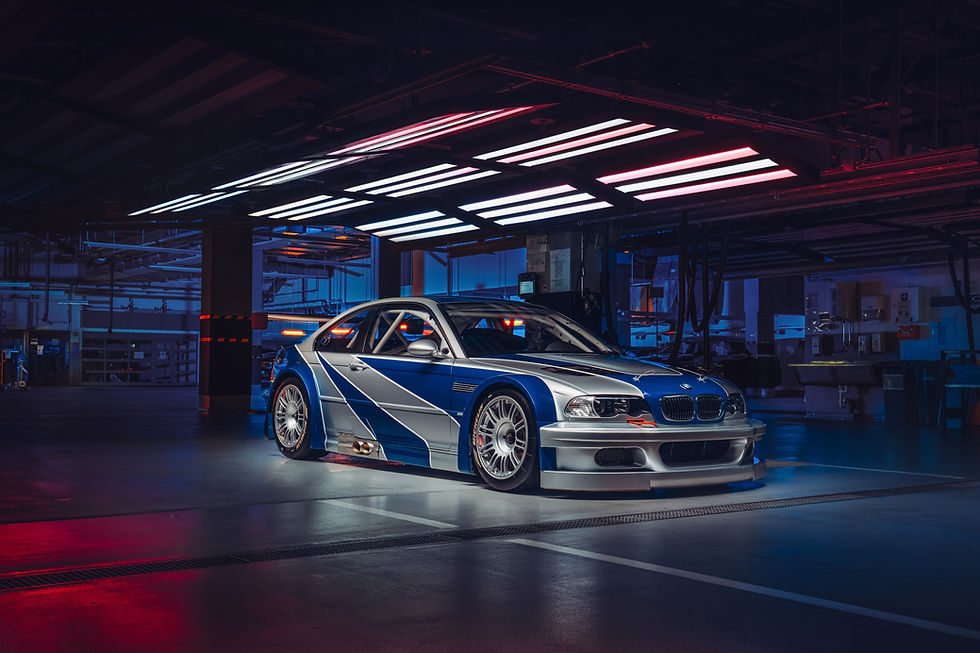
This video was one of several ways that the M3 GTR remained in the car community’s consciousness well past its retirement from racing. It also featured in a number of video games, most notably Gran Turismo and as the antagonist’s car in Need for Speed Most Wanted (2005). It arguably became the most iconic car in the franchise, and even made it onto the game’s front cover.
For younger generations, including myself, this was a gateway to learning about not just the M3 GTR but the BMW brand as a whole. The M3 GTR’s short run of domination made it a legend of sportscar racing, rightfully earning it a place in the BMW museum, but it’s reinvention as a video game feature elevated it to become a car culture icon.
Photo/video credit: BMW Media.
This article was originally published on The Sportscar Database's social media.


Comments