A Failed Icon - The Lamborghini Murciélago R-GT/R-SV

Lamborghini’s stalled LMDh effort may not have succeeded at Le Mans, but what happened when it took its first factory-supported car to La Sarthe?
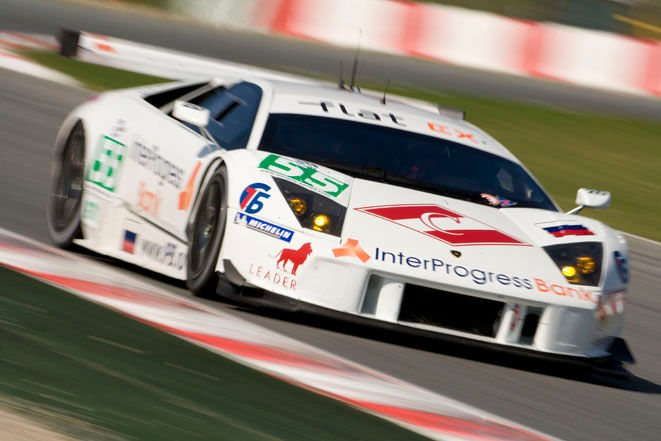
Lamborghini in motorsports is a tale of two halves – on the one hand, its GT3 racing efforts have yielded some impressive results, including an overall victory at the 24 Hours of Spa last year. On the other, it has never managed to achieve the lofty success in the top category of sports car racing that its peers like Ferrari and Porsche have.
Its stalled SC63 LMDh programme, which was absent from last weekend’s 24 Hours of Daytona after it was paused at the end of 2025, is a clear indicator that its ambitions to win at the top flight of sportscar racing still have a way to go. However, the SC63 is not Lamborghini’s first attempt to take on motorsport’s toughest endurance races, and the brand has come a long way in motorsports in a surprisingly short timespan.
At the turn of the century, Lamborghini had a fairly middling presence in racing; a failed Formula One engine project and a smattering of Diablo racers run by privateers like the Japanese Lamborghini Owners Club (JLOC) was all it really had to show for itself. That was until, in 2003, it unveiled it first factory-backed international GT competitor: the Murciélago R-GT.
After Lamborghini was acquired by Audi in 1998, the German automotive powerhouse had an interest in taking its new purchase back to the racetrack. Just five years later, it would reveal that ambition to the world at the IAA Frankfurt Motor Show.

The R-GT was built as a collaboration between Audi Sport and Reiter Engineering, a German-based engineering firm specialising in taking Lamborghini’s racing. It was based on Lamborghini’s latest road-going supercar, the Murciélago, which had been revealed two years before.
The Murciélago was reinvented as a GT racer with the primary aim of racing at Le Mans, meaning it was built to meet ACO regulations. By adhering to the ruleset for Le Mans’ governing body, the R-GT could compete in series such as the American Le Mans Series and at the pinnacle of endurance racing, the 24 Hours of Le Mans.
The R-GT may have been a factory-backed racing effort, but all of its examples were sold to privateer race teams. Japan-based JLOC acquired the first R-GT chassis, and would purchase three more before the year was out. The remaining examples went to DAMS in Europe and Barber Krohn Racing for competition in the American Le Mans Series. In total, just 11 R-GTs were produced between 2003 and 2009.

JLOC is by far the most synonymous with the R-GTs racing efforts, and with Lamborghini customer racing in general. The organisation was founded in 1980 by a group of particularly enthusiastic Lamborghini Miura owners – it existed on-and-off throughout the 1980s until a crackdown on group driving in Japan forced them to take to the circuit. The JLOC racing team was formed in 1994, and immediately contested the Japanese GT Championship (JGTC) with a lightly modified Countach road car.
Unsurprisingly, the Countach was no match for the Japanese automotive giants of Toyota, Nissan and alike, and it scored a career best finish of eighth. For 1995, JLOC’s relationship with the Lamborghini factory grew and they were given a trio of Lamborghini Diablo Jotas to race in Japan.
They had greater ambitions, however, and asked Lamborghini to give them a car to race at Le Mans; the factory contracted UK-based engineering firm Amos Racing to build the Diablo Jota GT1 LM, but legal disputes between Amos and Lamborghini meant it never raced at Le Mans. The Diablo Jota did race in a BPR Global GT race at Suzuka in 1996, making it the first Lamborghini to race in the ACO’s fabled GT1 category.

JLOC would campaign a revised Diablo GT-1 in Japan between 1997 and 2000, despite originally aiming to race in Europe. The car was re-homologated in 2001 as the Diablo JGT-1, using the same engine and gearbox but a reworked chassis and suspension, and other parts specially-built for JGTC competition.
The Murciélago R-GT set out top achieve what the Diablo couldn’t: to race at Le Mans. Its 6-litre, dry-sump aluminium V12 made nearly 600bhp; this power went entirely to the rear wheels (unlike the all-wheel drive Murciélago road car) to adhere to ACO rules. The long, curved mid-engined Lamborghini stood out next to its more muscular competition from Porsche, Saleen, Lister and Ferrari.
The carbon fibre body was built onto a tubular steel frame, shedding 550kg from the road-going Murciélago. As was the case with most GT cars of the era, the R-GT’s party piece was its engine – the shrieking naturally-aspirated 12-cylinder quickly became a fan favourite, and is probably what the R-GT is best known for today.
It was set to race in late 2003, but didn’t make its racing debut until the FIA GT round in Valencia, in 2004. With a young Oliver Gavin and Peter Kox at the wheel, the car scored a maiden third place on debut, behind a pair of Ferrari 550 GTS.
Speaking after the race, Gavin admitted that the result could have been even better had a loose fuse not delayed them in the pits. It was a strong debut for Lamborghini’s first factory-backed GT effort, but the car’s momentum would soon stall.

Barber Krohn’s American Le Mans campaign with the R-GT yielded middling results, and Lamborghini’s R-GT efforts in the FIA GT Championship didn’t see much progress until 2007. It won the opening round at Zhuhai in March, before taking a second place in Bucharest later that year.
At Zhuhai, favourable pit stop strategy in the second half of the two-hour race saw Christophe Bouchut and Stefan Mücke cross the line ahead of a pair of chasing Corvettes. The top three were separated by just four seconds in the nail-biting closing laps.
Two R-GTs entered the 2007 24 Hours of Spa, but neither finished. It would return a year later, finishing in eighth place.

The GT1 class at Le Mans was the R-GT’s real calling, and it did manage to contest the event on three consecutive occasions between 2006 and 2008. JLOC finally realised its dream of racing at Le Mans, and campaigned most of the R-GTs entered in the race across the three year period. Despite JLOC's rise from hobbyist racing group to genuine Le Mans contender, no R-GT ever managed to finish the event.
A derivative of the R-GT (the RG-1) was campaigned by JLOC in the Super GT Championship in Japan. The RG-1 didn’t achieve much, but it was responsible for the R-GT platform’s only championship victory. It would win the debut season of the Asian Le Mans Series with a class victory and third place overall at the Okayama 1000km. However, due to the cancellation of other rounds in the championship, the Okayama race was the only event on the Asian Le Mans calendar. Its 2009 championship win would also mark the last year of the R-GT’s competition career.

For 2010, the FIA GT Championship was replaced by the renewed FIA GT1 Championship. The ACO’s new GT1 regulations aligned with the release of a more extreme Murciélago road car: the SV.
Reiter Engineering were tasked with evolving the R-GT to create the Murciélago R-SV; it was essentially the same car, but with aerodynamic and suspension changes to adhere to the new regulations. An uprated 6.5-litre V12 kept that sonorous shriek that fans had grown to love.
It fared slightly better than its R-GT predecessor, taking a handful of podiums and victories at Navarra and Spa-Francorchamps in the its opening season. It would return in 2011 to repeat the victory at Navarra, and take another at Zolder for good measure.
The R-SV would take on Le Mans just once, with JLOC in 2010 (courtesy of an automatic invite from the R-GT’s championship victory in Asia). It failed to finish once again.
Much like the R-GT, the Murciélago R-SV was never a serious championship contender and, were it not for the iconic car upon which it was based, or the V12 power plant which propelled it to a handful of victories in its career, the Murciélago’s race variants would probably be forgotten.
Lamborghini’s first factory-backed GT racer can still be found competing in heritage GT series around the world, and examples occasionally come up for sale.
While it was never the most successful, the R-GT was a major milestone in Lamborghini’s racing history – it was the predecessor to its GT3 racing programme and ignited a new interest in sports car competition. The partnership between Lamborghini and Reiter Engineering birthed the first Gallardo GT3 car, which directly led to the Lamborghini racing exploits that we see today.

Thanks to Reiter Engineering for the images found in this article.
Check out The Sportscar Database's social media channels for more.


Comments